
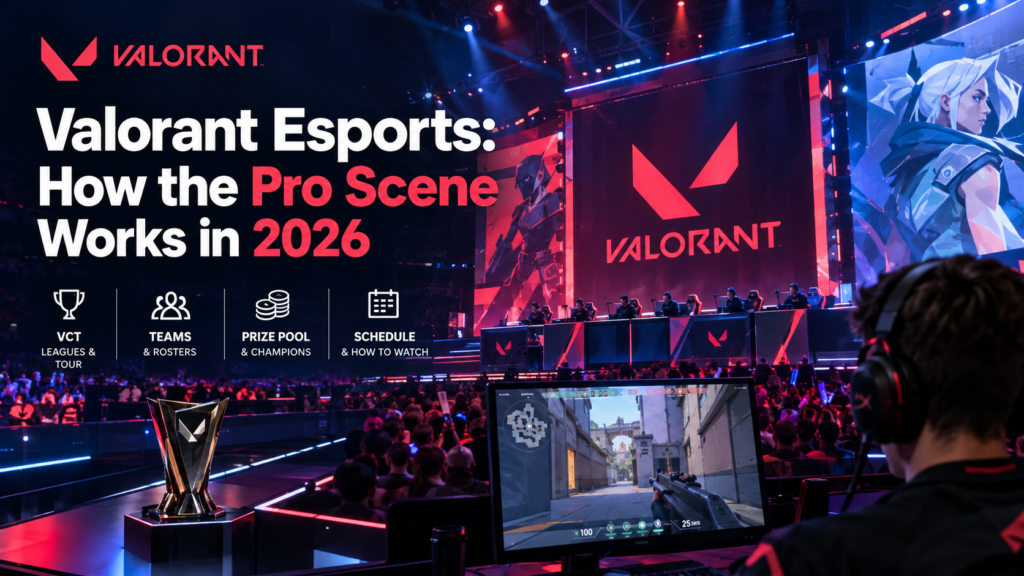
Late September, Shanghai, a packed arena. Five players on stage, one map left, and the loser goes home. That’s Valorant esports right now.
If you’ve never watched it, it probably looks like a mess. Leagues, tours, regions, brackets, and team names that all start to sound alike. Here’s the short version of how it fits together.
What Is Valorant Esports?
Quick refresher on the game first. Valorant is a shooter from Riot Games, five players against five. Attackers try to plant a bomb called the Spike, and defenders try to stop them. The first team to win 13 rounds wins the map. Every player also picks an agent, which is basically a character with special powers, and that’s why two rounds on the same map can look nothing alike.
Now add salaries, sponsors, and an arena full of people. That’s Valorant esports. Riot runs the major events itself, so a match in Europe follows the same rules as one in Asia.
The Valorant Champions Tour (VCT) Explained
Everything runs through the Valorant Champions Tour, or VCT. Riot built it, and Riot runs it. Simple as that. “Franchised” just means Riot gave those teams long-term spots, so they don’t have to fight through qualifiers every year.
At the top there are four leagues (the Americas, EMEA, the Pacific, and China) with 48 franchised teams between them. Teams play at home first. The best ones then fly out to meet teams from other regions. If you follow soccer, it’s the same shape: a local league all year and a World Cup at the end.
How Valorant esports Works Across a Season
A season starts with kickoff. This year it used triple elimination, so a team only goes home after its third loss, and the top finishers got tickets to Masters Santiago. Regular league play came next, then a second Masters, then Champions.
Riot changed the regular season too. Last year’s groups are gone. Now every team plays the same number of matches before the playoffs, which is simpler and, I think, fairer.
Smaller teams aren’t shut out either. Challenger leagues still exist, and in 2026 they get a new path to Champions. There’s also VCT Game Changers, a separate circuit for women and marginalized genders, with its championship set for October and November.
Here’s the catch, though. The franchise system ends after this year. In 2027 the VCT goes back to open qualifiers, so Champions 2026 is the last one played under the current setup. That’s a little sad, honestly, and a decent reason to actually watch this fall.
Valorant Masters and the Road to Champions
Valorant Masters events are the big international stops before Champions. In 2026 they were in Santiago and London. Santiago was the first international VCT event in Latin America, and London was the tour’s first time in Britain. Both used 12 teams, so there were more matches and more points to fight over. Teams use them to see where they really stand against other regions.
If you want more like this, Daily Gaming Stake covers Valorant esports and other pro games.
Valorant esports Teams to Know
Sixteen teams reached Valorant Champions 2026. NRG is the defending champion, and they earned it the hard way, beating Fnatic 3-2 in Paris in a final fans still talk about. It peaked at 1.47 million live viewers.
The rest of the field includes Paper Rex, Team Liquid, G2 Esports, Karmine Corp, and Team Vitality. China sends several teams, EDward Gaming and JD Gaming among them, and this time they’re playing in front of their own fans. Does that help? Probably. Nobody can prove it.
I can’t tell you who wins. Nobody can. But if you want one storyline to follow, pick NRG. Defending a title is hard, and everyone else wants to be the team that ends it.
Valorant esports Prize Pool
The prize pool at Champions 2026 is $2,250,000, split by where teams finish. The winner gets the biggest slice. Big number, sure, but it isn’t the full story, since players also get salaries and teams bring in sponsors. What the pool really adds is pressure. When that much money is riding on the next map, one bad round can turn ugly fast. And money isn’t even the main goal. Every team wants the title on its resume.
Valorant Champions 2026: The Tournament Format
Champions 2026 is in Shanghai, the first time China has hosted it. Sixteen teams, four groups of four. Group matches are best of three, so win two maps and you win the match. That means a team can drop a map and still come back, which changes how careful teams play the first one. The top two from each group move on. Before every match, teams pick and ban maps, so the strategy fight starts before anyone fires a shot.
After that it’s double elimination. Lose once and you fall to the lower bracket. Lose twice and you’re out. The lower bracket final and the grand final are best of five, and the top four plus the grand final are at Mercedes-Benz Arena. This Valorant tournament format is forgiving, which explains why a rough opening day doesn’t always sink a good team. The Wikipedia page for Valorant Champions 2026 lists everything in more detail.
Valorant Esports Schedule and Where to Watch
Champions 2026 started in late September and runs into mid-October. Groups first, then the playoffs, then the grand final. Match times move around, so check your time zone. Yes, that’s boring advice. It still saves you from missing the first map.
Riot streams big matches for free, often on Twitch and YouTube. Start with the official Valorant esports site for the schedule and stream links. Many matches land at odd hours for US viewers, so a reminder helps. Also, pick a team to root for, even a random one. Matches feel completely different once you care who wins. Can’t watch live? Check the same channels afterward for highlights, though I’d try one live match just for the crowd noise.
Start Watching Valorant Esports Today
You don’t have to learn every player. Know the round basics, pick a team, and watch one group match. Give it an hour and it starts to click. For more guides and match news, keep an eye on Valorant esports at Daily Gaming Stake. Then go find out who moves on.
Valorant esports FAQ
How does Valorant esports work?
Riot runs a pro circuit called the VCT. Teams play in regional leagues and then in international events like the Masters. The season ends with Champions, where the best teams fight for the world title.
What does VCT stand for?
Valorant Champions Tour. It’s the official pro circuit run by Riot Games.
How big is the Valorant Champions 2026 prize pool?
It’s $2,250,000, shared among the teams by final placement.
Who is the defending Valorant Champions winner?
NRG. They beat Fnatic 3-2 in the 2025 final in Paris.
Is Valorant esports free to watch?
Yes. You don’t have to have a ticket to watch Riot’s games, since the organization broadcasts huge matches free on its channels.