It’s 11 p.m. on a Wednesday, and a trade offer pops up on your phone. Your running back for his wide receiver. Sounds fine? Maybe. You honestly can’t tell, and the other manager wants an answer by morning.
That’s when a fantasy football trade analyzer earns its keep. It takes two sides of a deal and puts numbers on them. Below you’ll see how it works, how to put one to work, and where it can fool you.
What a fantasy football trade analyzer does
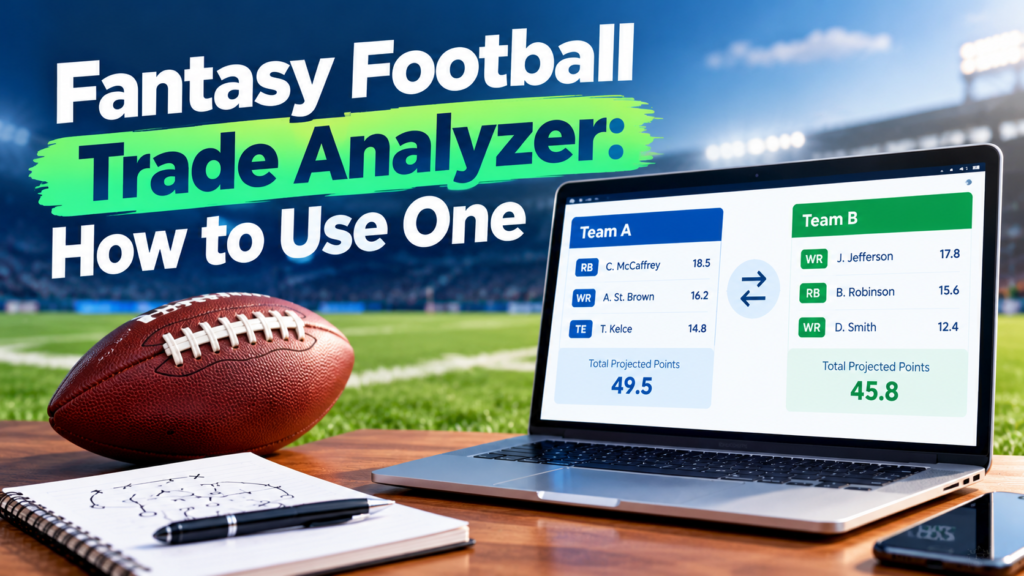
The tool makes the comparison between what you give and what you get back. As you place players on each team, the tool calculates their total point values. The higher total wins.
As an example, the tool Razzball provides allows you to select a type of scoring (standard, half PPR, or full PPR) and choose players for teams A and B. The total points are calculated and shown next to each other. It is also possible to show points per game instead of the season statistics if the player missed some games.A fantasy football trade analyzer doesn’t make the decision. It gives you a second opinion. Your gut still gets a vote.
How a fantasy football trade analyzer gets its numbers
Most of these tools lean on projections. Razzball says its analyzer uses rest-of-season projections, and it shows projected stats and not just one mystery number. The company describes other tools as a “black box” that only hands you a total.
I like seeing the stats.If the value of a wide receiver is based primarily on receptions, that’s easily detectable. The same applies to the value of a running back whose overall worth depends entirely on touchdowns. Touchdowns are hard to predict, so you’d want to be careful there.
Projections also update during the season as injuries and roster moves happen. Ensure the tool is always updated, since an outdated figure is worse than having no figure at all.
How to use a fantasy football trade analyzer, step by step
Start with your league’s scoring, because a fantasy football trade analyzer can’t guess it. This matters more than people think.In a PPR league, catches are worth more than in a normal league, meaning that a receiving back would be more valuable in a PPR league. Remember to change the scoring system of the tool accordingly.
Next, enter both sides. Put the players you’d send on one side and the players you’d get on the other. Look at the totals, then look at the per-game numbers.
Now comes the part most people skip. Read the details. Where does the gain come from? A trade that looks even can hide a problem, like getting a star but losing the depth you need on bye weeks.Last, sleep on it if you can. The offer will still be there tomorrow, and a calm look beats a panicked tap.
What an analyzer can’t see
Here’s where I’d slow down. A fantasy football trade analyzer is a calculator, and calculators don’t know your team.It doesn’t know that you’re stacked at running back and thin at wide receiver. A fair trade on paper can still wreck your lineup if it fills a spot you didn’t need. It also doesn’t know your playoff schedule or whether your league starts two quarterbacks.
That last one matters. According to Razzball’s website, fantasy football players should increase quarterback scoring by approximately 20%. However, even the tool creators agree that manual adjustments are necessary. Use their calculations but combine them with one’s expertise.
Injuries are another area to watch out for. Projections could lag behind updates. My advice would be to consult their website before making any conclusions about players. To find the necessary player info, Razzball advises checking players’ biographies, schedule, game statistics, and depth chart. I’d add one more habit: read the injury report yourself.
Trade value chart or analyzer?
You’ll see both terms. A trade value chart is a list that gives each player a number, so you can add up the two sides yourself. An analyzer does the adding for you, and it can often account for your scoring settings.
Charts are quick and easy to read. They’re also generic, which means they might not fit your league. An analyzer that lets you pick scoring tends to fit better. Honestly, I’d use both and see whether they agree. If they don’t, dig into why.
Mistakes people make with a fantasy football trade analyzer
The most important thing is considering the answer a verdict. A system declares “you win by 12 points,” and everyone hits Accept without any doubts.Twelve points of what, over how many weeks? Does it matter for your lineup?
Another is chasing last week’s big game. One huge performance can swing a total, and the next week the player disappears. Look at the longer picture.
Then there’s ignoring the other manager. Consider why they want to make that deal. Perhaps it’s for depth, perhaps they’re dealing out of a bye week situation, or perhaps they have information you don’t. A smart offer often helps both teams. A lopsided one tends to start arguments in the group chat.
Trade review and deadlines
Your league’s rules matter as much as the math. Many leagues let the commissioner review trades. Yahoo’s help page on commissioner trade review explains how it works in private leagues. The commissioner can either allow or veto a trade. If they allow it, Yahoo says the trade processes right away, even if time is left in the review period. The only people notified about the trade will be the managers involved in the trade and the commissioner, while others see the notice of pending trades.
Make sure to verify all these details in your settings before making any offer. Find out who checks for trades, how long it takes, and what date is the trade deadline in your league. Deadlines differ from league to league, and missing yours means you’re stuck with the roster you have.
Your next step
Pick one trade you’ve been mulling. Open any fantasy football trade analyzer and enter your league’s scoring. Run the numbers, then write down two reasons the deal helps you and one reason it might not. If the reasons hold up, send the offer. If they don’t, walk away.
Want more fantasy help? Our list of fantasy football sleepers is a good place to look for pickups that could make trades easier. Browse our fantasy sport articles for more. Use the fantasy football trade analyzer as a guide, not a boss, and your team will thank you.
FAQ
What is a fantasy football trade analyzer?
It’s a tool that compares the players on both sides of a trade. It adds up projected points so you can see which side comes out ahead.
Are trade analyzers accurate?
They will be as accurate as their projections and your settings. There are many factors such as injuries, need of roster and other things that could change the answer, hence take it as a guideline.
Does the scoring system affect the value of trades?
Absolutely. The full PPR scoring system pays more for catching than the standard system, thus making pass-catchers more valuable.
What’s the difference between a trade chart and an analyzer?
A chart lists one value per player for you to total. An analyzer totals both sides and can often use your scoring settings.
Who approves trades in a league?
It depends on your league. Some Yahoo leagues give the commissioner the final say, so read your own rules.