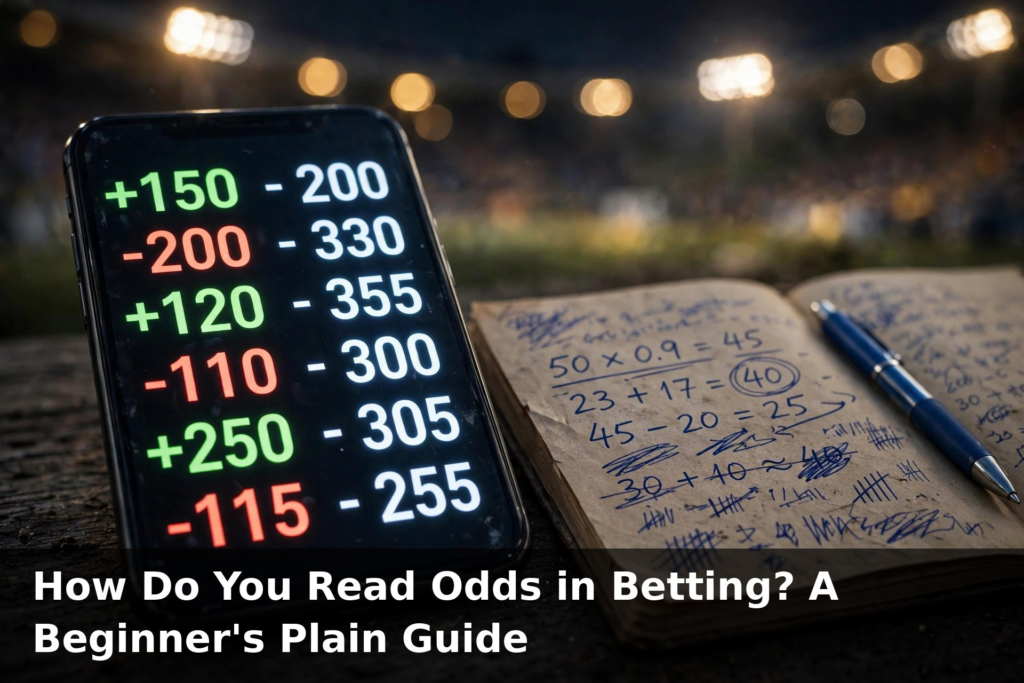
The first time I looked at a betting slip, I stared at it like it was written in another language. +150 here. -200 there. I nodded along like I understood, then went home and searched it all on my phone. So if you are asking how do you read odds in betting and feeling behind, you are not behind. Nobody explains this stuff slowly.
A friend tried to help once. His explanation was, “Plus means good, minus means bad, you’ll figure it out.” Thanks, mate. Genuinely useless. Odds are not hard once somebody breaks them into small pieces, with actual numbers.
What odds are really telling you
Strip everything else away and odds do two jobs at once. They tell you how likely the bookmaker thinks something is, and how much you get paid if it happens. That’s it. Every format, every sport, every strange little number comes back to those two things.
And odds are not a neutral prediction. They are a price, with a margin built in for the seller. Once I saw them as a price tag on a possibility, the fear drained out of them.
American odds, the plus and the minus
If you are betting in the US, American odds explained properly starts with one anchor number: 100. Everything is built around a hundred dollars. A plus sign means the underdog — the number is your profit on a $100 stake. A minus sign means the favourite — the number is what you must stake to profit $100.
So +150: put down $100, and if it lands, you profit $150 and get your $100 back on top — $250 in total. And -200 is the opposite shape: stake $200 to profit $100, getting $300 back if it wins. The favourite pays less because it is more likely. Not generosity. Arithmetic wearing a smile.
The mistake I made with minus odds
True story, and it still stings a bit. Early on, I saw a team at -150 and read it as “I win 150.” I put $50 down feeling quietly clever, it won, and my account credited me a profit of about $33. I refreshed the page like the rest of my money was stuck in transit. It wasn’t. At -150, $50 only ever buys a $33.33 profit — the number is the stake needed for $100 profit, not the prize. Fifty divided by 150, times 100.
The number works in opposite directions depending on the sign. Plus: your profit on 100 staked. Minus: your stake to earn 100. Remember one sentence from this page — make it that one.
Decimal odds, the format that does the maths for you
Cross the Atlantic and the numbers change costume. Decimal odds are the format I wish everyone used, because nothing is hidden in them. A decimal like 2.50 means your total return is your stake times that number. Ten dollars at 2.50 returns $25 — including your original $10, so your profit is $15. One multiplication. Done.
Converting is easier than people make it sound. A plus American price of +150 is decimal 2.50. A minus price of -200 is decimal 1.50. Anything under 2.00 is a favourite, anything over it is an underdog. If you are weighing up decimal vs fractional odds while you learn, start with decimal. It never lies about the total — and the total is what your bank account cares about.
Fractional odds, the old-school version
Fractional odds are the ones all over British racing, written like 5/1 or 1/2, and they read as profit over stake. So 5/1 — “five to one” — means $5 profit for every $1 staked: a $10 bet profits $50, plus your stake back. And 1/2 is the favourite’s version: $1 profit for every $2 staked, so $10 returns just $5 profit. Second number: what you put in. First: what you get out.
I’ll be honest, fractions made my brain ache for longer than decimals did. But they click — they are just a ratio, the same kind you used in school and immediately forgot.
What the numbers say about probability
Here is the layer most beginners never get shown. Odds carry an implied probability — a rough percentage chance hiding inside the number. For a plus price, divide 100 by the odds plus 100: +150 gives 100 divided by 250, which is 40 percent. For a minus price, divide the odds by the odds plus 100: -200 becomes 200 divided by 300, about 67 percent.
Why bother? Because it lets you argue with the bookmaker in plain words. Priced at +150, the book is saying that team wins about 40 times in 100. Think they win more often than that? The price might be fair. Think less? Walk away.
The vig, or why the book always eats first
Now the part the adverts skip. Add up the implied probabilities on both sides of a market and you will get more than 100 percent — often 104 or 105. That extra slice is the vig, also called the juice: the bookmaker’s built-in margin. It’s how they get paid regardless of who wins. Both sides are priced a touch worse than the true odds.
It just explains the business model: you are shopping at a store that has already marked everything up. Knowing the markup exists makes you a calmer customer.
Reading a real line without panicking
So you open an app and see Chiefs -150, Bills +130, sitting next to a spread and a total. Slow down. The minus tells you Kansas City is the favourite, and a $100 profit needs $150 staked. Buffalo at +130 profits $130 on a $100 stake — the underdog price. The other numbers nearby, the -3.5 and the 47.5, are the spread and the points total. Different bets entirely.
My routine now is boring, and boring is good. Check the sign, do the hundred-dollar maths, turn it into a percentage, ask whether I agree with it. If the answer is a shrug, I close the app.
The bit about money I won’t skip
However well you learn how to read betting odds, the odds themselves never promise you anything. They include the bookmaker’s margin, and over a long run of bets the maths tilts against the casual player. Betting is entertainment you pay for, like a ticket. The moment it becomes a plan for income, the numbers stop being a puzzle and start being a problem.
Keep it small, keep it legal where you live — the rules differ state by state — and you generally need to be 21 or older. And never chase a loss by reading the next set of odds through angry eyes. Angry eyes misread everything. Ask me how I know.
Your next step
Do this before you ever stake a cent. Open any sportsbook, pick one game, and read the two prices out loud: “This one needs $150 to profit $100. That one profits $130 on $100.” Then turn both into percentages. It feels daft for about four minutes. Then it sticks — and the screen stops looking like a foreign language and starts looking like a price list with a margin, written by a shop that hopes you won’t do the maths. Now you can.
FAQ
What do odds mean if they have a minus sign?
A minus sign marks the favourite, and the number is how much you must stake to profit $100. So -200 means staking $200 to make $100 profit, stake returned on top if it wins.
How do you read odds in betting if they are written as fractions?
Read them as profit over stake. 5/1 means $5 profit for every $1 staked, while 1/2 means $1 profit for every $2 staked, stake returned too.
What is the difference between American and decimal odds?
Same prices, different clothes. American odds use the plus and minus system built around $100, while decimal odds give one number you multiply by your stake to get the total return, stake included.
Can reading odds well guarantee I will win money?
No. It only means you understand the price and the bookmaker’s margin inside it. That helps you judge value, but no odds format turns betting into reliable income.