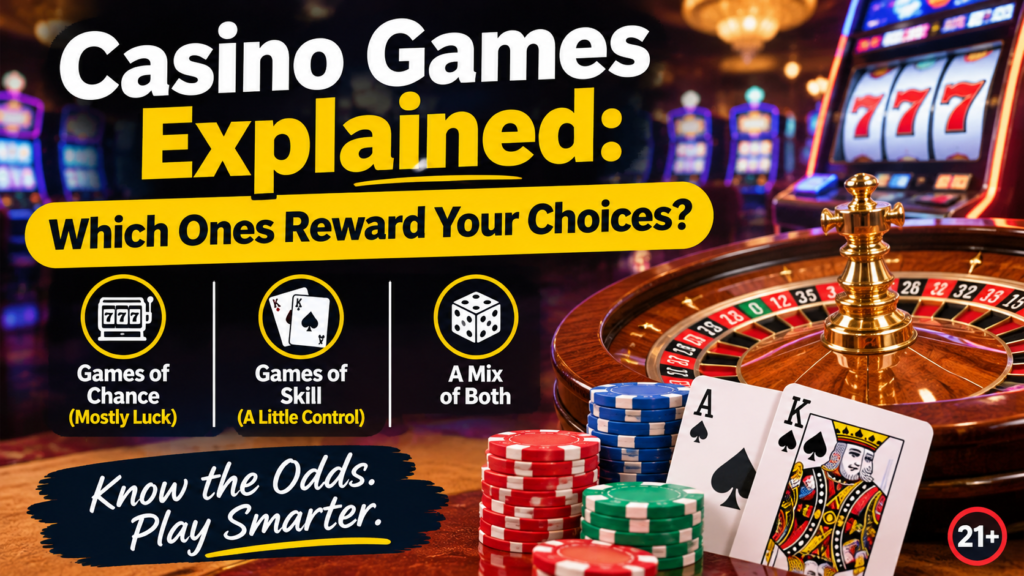
Most guides to casino games go game by game, with rules first and warnings last. I’m going to sort them by a single question instead: when you play, do your decisions change anything? For some games the answer is no, for some it’s a little, and knowing which is which tells you more than any rulebook.
This is for adults 21 and over, for information only. I can’t promise a win, and nobody honestly can. I haven’t tested any site or app for this post, so I won’t name or rank one. Sourced facts are marked, and my own opinions are labeled as mine.
The one idea behind every game
Every casino game has a house edge. That’s the gap between what a bet really pays and what the odds say it should. A health authority page I read, which appears to be from New Zealand, puts it as the difference between true odds and the casino’s payout, usually shown as a percentage. Its summary is short: “The odds are always in the casino’s favor.”
NSW’s Office of Responsible Gambling says the same thing another way. Each casino game has a built-in advantage, so the house keeps a small share of every bet, and players are likely to lose over time. Skill can matter, but it can’t guarantee a win.
Keep that in mind, and the rest of this post makes more sense. The sorting below is a games of chance vs. skill split, and it’s only about how much room you have to play well within that edge.
Group one: nothing you do matters.
Slot machines
Slots are the purest of the casino games. The UK Gambling Commission explains slot machine RTP like this: return to player is the percentage a machine pays back to players over its lifetime. That is a long-run average, not a promise for one session. It also says there is no minimum RTP and that the odds on a random machine stay the same from spin to spin.
So no spin is “due.” Nobody can time a machine, pick a lucky one, or read its mood. One regulator point is worth knowing: Las Vegas Advisor reported in December 2025 that casinos don’t disclose the return of individual machines, so a player usually can’t compare them. That’s a reporting claim I’m passing along, and I haven’t checked it myself.
Rules differ by place. Tasmania’s Liquor and Gaming Branch, in a March 2018 player guide, says its poker machines must return at least 85 percent and that most pay out around 90 percent. That’s one Australian state’s rule, not a US one. Check your own state regulator for the figures that apply to you.
If slots are your interest, our online roulette guide covers a game that behaves in much the same way, though on a wheel.
Roulette
The ball lands on one of 37 numbers, or 38 on a wheel with a double zero. The NZ page has a line I like: “The little ball has no memory.” Each spin is independent of the last.
The edge comes from the payout. A single-number bet pays 35 to 1, but the true chance is 1 in 37 (or 1 in 38). On a double-zero wheel, the page gives the house edge as 5.26%, meaning you can expect about 95 cents back for every dollar bet. Tasmania’s guide uses a single-zero wheel: bet $1 on every number, and you spend $37 and get back $36. That works out to roughly 2.7%, which is my own arithmetic, not their figure.
Those roulette odds differ a lot between the two wheels. That’s the one real decision roulette gives you, and you make it before you place a chip.
Group two: you matter a little.
Blackjack
Among casino games, this is where your choices do count. NSW says skill can slightly reduce the house edge in games like blackjack, but it can’t remove it. The UK Gambling Commission lists blackjack among the unequal-chance games where the house keeps an edge, even though players make decisions.
What does “slightly” mean? I don’t have a verified number from a regulator, and the figures I found in promotional articles didn’t agree with each other, so I’m leaving a number out. A basic blackjack strategy chart is the usual tool, but I haven’t checked any, so I won’t point to one. If you want a figure, look for the published rules for the table you plan to sit at, because they vary.
Poker
The NZ page puts poker in the partial skill group, alongside blackjack. There, your judgment can improve your chances of a winning guess, but chance still plays a big part. Against other players, other people’s decisions also matter. NSW lists them among the things that affect outcomes.
I’d add a personal view here: skill takes real time to build, and a casino table is a costly classroom. That’s an opinion, not a source.
Group three: a mix of both
Some casino games sit in between. Keno is a lottery-style game, and Tasmania’s guide says its keno must return 75 percent of the money wagered, so the venue keeps 25 percent. The NZ page names baccarat and the money wheel as chance games too but doesn’t explain how they work, so I’ll leave their rules to the venue.
If you want to see the whole spread in one place, this table sums up what the sources above say.
Game: How much your choices matter What a source says about slots None of RTP averages out over the long run, with no minimum. Roulette None, apart from picking the wheel 5.26% edge with a double zero (NZ page) Keno None 75% return in Tasmania’s rules Blackjack A little skill can slightly cut the edge (NSW) of poker. Some judgment helps; chance remains (NZ page).
The room itself
Casino games aren’t the only thing working on you. NSW’s page says casinos are “designed to capture your attention and keep you engaged,” with bright lights, noise, and visual cues built to keep you playing longer. Big wins bring flashing lights and loud sounds, which can make winning feel more common than it is.
Chips matter too. NSW says using chips instead of cash “can make it harder to track losses and stay in control.” My own habit is to treat chips as money the moment I get them, and I’d suggest you do the same. The page doesn’t mention clocks or free drinks, so I won’t claim anything about those.
Setting yourself up
None of the sources promise a system for casino games, and Tasmania’s guide says plainly that no strategy helps in lotteries and scratch tickets, that past results don’t affect the next game, and that your chances don’t improve the longer you play. Its closing line is “It’s all about control. Know the facts before you play.”
Here’s what the sources suggest, plus a bit of mine:
- Set a limit on time and money before you go, and stick to it (NSW, Tasmania, the NZ page).
- Use only money set aside for entertainment; never rent or pay bills.
- Take regular breaks, and skip alcohol while you play.
- Don’t borrow to keep going, and don’t chase losses.
- Mine: decide the number first and treat it as already spent.
Picking where to start
For casino games for beginners, my suggestion is to choose one that you want to play in the evening. Want something relaxed with no decisions? Slots and roulette ask for nothing but a budget. Want to think? Blackjack rewards it a little. Either way, browse more in our casino section.
The honest summary of casino games is simple. The house has an edge in everything; your choices count most in blackjack and poker, and the best skill you can bring is knowing when to stop.
FAQ
What are the most common casino games?
Slots, roulette, blackjack, poker, baccarat, and keno are the ones the sources above mention. Availability depends on your state and venue.
Which of the casino games has the best odds?
I can’t name one from a verified source. Every game favors the house, though NSW notes that skill helps a bit in blackjack.
Can you beat the house edge?
No source says you can. Over the long run, the house edge means most players lose.
What does RTP mean?
RTP stands for Return to Player. It’s the share a game pays back over its lifetime, per the UK Gambling Commission. It can’t predict a single session.