
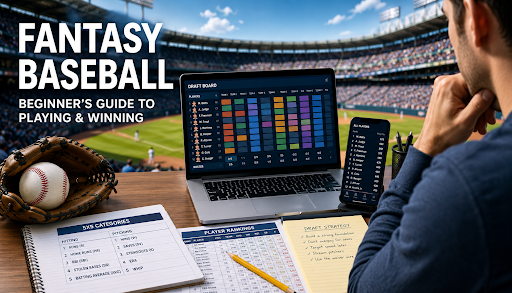
Your coworker corners you in the break room in March, asking if you want to be in on the office league. You say yes before you actually know what you agreed to. Now it’s April, you’re staring at a draftboard with 300 names on it, and you recognize maybe thirty of them. That’s most people’s first real brush with fantasy baseball, and it’s a rougher entry point than it needs to be.
None of it is actually complicated once someone walks you through it properly. It just tends to get explained by people who’ve been playing for a decade and forgot what round one felt like the first time.
What Is Fantasy Baseball, Actually?
A fantasy baseball game is one whereby one picks real MLB players to join their roster which is virtually existing through the app and scores points depending on the performance of those players in the real matches and beats their opponents in these scores.
There are two very different ways to play it, and this matters more than people realize going in. Season-long leagues have you draft a full roster before opening day and manage it for six months straight, working the waiver wire, weighing a trade, and benching a guy who’s ice-cold right now. Daily fantasy skips all of that. You build a lineup for one day, watch it play out that same afternoon, and done. No need for a long-term strategy, no need for a team that needs watching, just one chance.
Season-Long vs. Daily: Which One Are You Actually Signing Up For?
It’s here that more people get confused about fantasy baseball than anywhere else. People say, “I play in a fantasy baseball league,” but really, what they’re saying doesn’t make sense at all.
A season-long league, the kind run through Yahoo, ESPN, or CBS, tracks the real MLB calendar. Draft in March, then spend the next six months adjusting as guys get hurt or catch fire. It’s slow. I’d argue that’s actually the appeal if you like following the sport closely instead of caring for one afternoon and moving on.
Daily fantasy, on DraftKings or FanDuel, works nothing like that. You pick a lineup under a salary cap, it plays out over a single day’s games, and the standings wipe clean tomorrow. Great if you want in and out fast. Less great if you were hoping for that slow-burn story where your twelfth-round sleeper turns into your league MVP by August, because that arc doesn’t exist here.
How Scoring Actually Works
Most season-long leagues run on one of three formats, and which one you land in changes how you should draft, sometimes completely.
Roto, short for “rotisserie,” tracks your team’s season totals across a set of categories, typically five hitting and five pitching, the classic 5×5. Home runs, RBIs, stolen bases, batting average, and runs scored on the hitting side. Wins, saves, ERA, WHIP, and strikeouts on the pitching side. Every team gets ranked in each category, and those ranks get totaled for a final standing.
Points leagues are the simpler version on paper. Every stat carries a set point value, maybe a home run’s worth of 4 points, a strikeout by your pitcher worth 1, and your team just piles points up all season. Whoever has the most wins. Nothing to balance across categories, just one number climbing.
Category leagues run head-to-head, week by week, trying to beat one opponent across the most categories that particular week. Think fantasy football matchups, except stretched across a full week of baseball instead of one Sunday.I wouldn’t say any of the three is objectively better. Points leagues tend to be kinder to a first-timer since there’s less to juggle. Roto rewards the people who genuinely enjoy optimizing a whole roster across ten categories for six months straight, which, fair enough, isn’t for everyone.
Draft Basics Nobody Explains Well
Your draft decides more of your season than most people want to admit.Standard rosters land somewhere around 23 to 26 players, a mix of starting lineup spots, bench depth, and pitching slots split between starters and relievers. Early rounds go to the safest, most productive hitters and the handful of elite starting pitchers left. Somewhere in the middle rounds, people start hunting for a specific skill, speed for stolen bases, a high-strikeout arm, or whatever their roster’s missing.
The late rounds are honestly where drafting skill actually shows up. Anybody can spot the obvious stars sitting in round one. Finding the guy nobody’s talking about in round 18 who quietly becomes your league winner, that’s the part that separates a good manager from someone just filling out a roster to have one.
Bring rankings into the draft, sure, but don’t get married to them. Runs on certain positions happen fast and without warning, and the guy you penciled in for round 9 is sometimes long gone by round 7 because three other teams had the exact same idea at the exact same time.
Managing Your Team Once the Season Starts
The draft’s the fun part, honestly. The waiver wire is where fantasy baseball actually gets decided over six months.
Players get hurt constantly across a 162-game season; that’s just the nature of it. Someone buried on your bench catches fire out of nowhere while a guy you took in round 4 quietly falls apart. Checking the waiver wire weekly, sometimes more often than that, is how teams that started strong don’t fade by July while everyone else’s roster stopped looking like it did on draft day.
Trades matter too, though fewer people use them well than you’d think. A fair trade actually solves something for both sides, not just yours. If you’re trying to steal your third outfielder just to be a closer, it doesn’t work.You can’t just give your third outfielder to someone else for their closer.
Is Fantasy Baseball Legal, and Is It Gambling?
Depends on which version we’re talking about, again.
A season-long home league with a small buy-in, the kind your coworker dragged you into, gets treated as a game of skill in most states and is legal accordingly, since the outcome leans heavily on roster management and player evaluation rather than pure chance.
Daily fantasy sites like DraftKings and FanDuel run under specific state regulations, and most states allow it. A handful restrict or flat out ban it. Worth a quick check on your state’s current rules before you deposit anything on a DFS platform, since that list moves around more than people expect year to year.
Getting Started This Season
Pick your format first, before anything else. Want the slower, season-long commitment? Find a league through Yahoo or ESPN; both are solid for a first-timer, and neither buries you in a confusing interface. Want something fast with no roster to babysit for six months? Daily fantasy on DraftKings or Fan A duel gets you playing the same day you sign up.
Read up on your league’s scoring before draft day, not during it. A few minutes with a scoring chart beats sitting there trying to work out categories live while the clock’s counting down on your pick.Keep your buy-in small the first year. Learning the rhythm of waiver claims and trade timing matters a lot more early on than actually winning your first season does.
Bottom Line
Fantasy baseball rewards the people who stay engaged for six months, not just whoever nails the draft. Pick a format that actually fits how much time you want to spend on this, learn scoring before you’re mid-draft trying to piece it together, and check the waiver wire more often than you think you need to.
Want more on how odds and scoring work across other sports? Check our sports betting guides or browse our full blog for more beginner breakdowns.
FAQ
What’s a keeper league?
A season-long league where you get to hold onto a few guys from your roster into next year instead of starting completely fresh. Changes how you draft too, since you’re thinking a season ahead on top of this one.
Is fantasy baseball gambling?
Depends which version. Season-long leagues get treated as a game of skill in most states, since managing your roster matters more than luck does. Daily fantasy runs under its own set of state rules, and those change more than you’d think, so it’s worth a quick check before you put real money down.
Should I draft based on rankings, or trust my gut?
Rankings are worth bringing to the draft, just don’t marry them. Positions run out fast — the guy you were saving for round 9 might already be gone by round 7 because three other teams had the exact same idea.
What’s the difference between roto and points leagues?
Roto ranks your team against everyone else’s across a handful of categories, then adds up those ranks. Points leagues skip the ranking and just assign a point value to every stat, then total it.
Do pitchers and hitters get drafted separately?
No, it’s all one draft. You’re just picking from the full player pool and filling out lineup and pitching slots as you go, usually mixing in both throughout