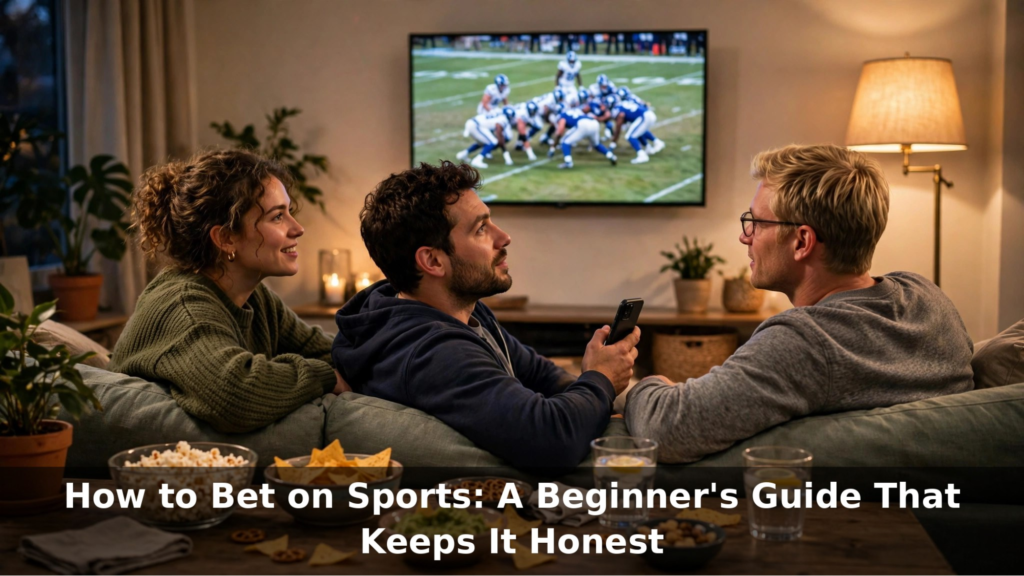
Picture this. You’re on a friend’s couch, the game is in the fourth quarter, and he pulls out his phone, taps twice, and says he’s got twenty bucks on the underdog. Then he starts talking about minus one-fifty and the spread, and you just nod along, because those numbers might as well be in another language. That was me not too long ago. If it’s you, you’re in the right place.
This guide explains how to bet on sports the way I wish someone had explained it to me — slowly, in plain English, without the hype. I’m not going to tell you betting is a way to make money, because for most people it isn’t. It’s entertainment, like a concert ticket. Once you see it that way, the rest gets easier.
Learning how to bet on sports starts with the odds
Odds do two jobs at once: they show how likely the sportsbook thinks an outcome is, and how much you’d get paid if it happens. The more likely something is, the less it pays. The less likely, the more it pays. It’s also worth saying out loud that the odds are built so the sportsbook keeps a small edge over time. That doesn’t mean you can’t win a bet — people win bets every day. It just means the prices are set by people whose full-time job is setting them, so keep your expectations where they belong.
What American odds are really telling you
Most US sportsbooks use American odds, so you’ll see numbers with a minus or a plus in front of them. A minus number, like -150, marks the favorite. It tells you how much you’d bet to win $100, so at -150 you put down $150 and, if your team wins, you get your stake back plus $100. A plus number, like +130, marks the underdog, and tells you what a $100 bet would win — $130 on top of your stake. At a smaller size, a $50 bet on that +130 underdog pays $65 plus your $50 back. Apps show the payout before you confirm, but doing the math by hand once makes it click.
Moneyline, spread, and totals are just three questions
Almost every beginner bet comes down to one of three questions. The moneyline asks the simplest: who wins the game? Pick a team, they win, you win, whatever the score. The point spread asks who wins and by how much — if a team is favored by 6.5 points, they must win by at least 7 for a bet on them to pay, and the half point is there so a tie can’t happen. Totals ignore the winner completely and ask how many points both teams score combined, with you betting over or under the sportsbook’s number. My honest advice is to start with the moneyline. One bet type understood properly beats five you half-understand.
Pick a legal sportsbook before you pick a team
This part isn’t exciting, but it matters. Betting is legal in many US states now, but not all of them, and the rules change from state to state. Some allow online betting, some only allow it in person, and some don’t allow it at all yet. You generally have to be physically inside a state where it’s legal to bet online, and usually 21 or older, so check your local rules before signing up anywhere. If it is legal where you live, stick to sportsbooks licensed by your state, since they follow real rules about holding your money and paying winnings. And read the fine print on any welcome offer first — a bonus you don’t fully understand isn’t really an offer.
Your bankroll is the boring part that saves you
A bankroll is money set aside purely for betting, kept separate from rent, bills, and groceries. Decide the amount before you place a single bet, and pick a number you could lose completely without it ruining your week. Losing streaks happen to everyone. If losing it all would genuinely hurt, the amount is too big. Then bet small pieces of it — a common beginner approach is one to three percent per bet, so on a $200 bankroll that’s two to six dollars a wager. Chasing a loss with a bigger bet is the fastest way I know to turn a fun hobby into a stressful evening.
Placing your first bet, nice and simple
The mechanics of how to bet on sports are simpler than the thinking behind them. Open your licensed sportsbook’s app, find your game, and tap the odds next to the outcome you want. That pick lands in a bet slip, where you enter your stake. Before you confirm, the slip shows what you’d get back if the bet wins — and that’s the moment to slow down and check the team, the bet type, and the stake, because plenty of bad betting stories are just someone tapping confirm on the wrong thing. For that first bet, keep it almost boring on purpose: a game you were going to watch anyway, the moneyline, a small stake. One game with a tiny bet on it teaches you more than ten guides, this one included.
Odds move, and that’s normal
Beginners often get confused when a line changes between morning and game time. A team opens at -150, drifts to -170 by the afternoon, and it doesn’t mean the sportsbook made a mistake. Lines move because money comes in unevenly on one side, a player gets ruled out, or the weather turns. The odds you get are the ones showing when you placed the bet, and later moves don’t change your ticket — so there’s never a need to rush just because a line is shifting.
The mistakes almost every beginner makes
The biggest one is betting with your heart. We all have a team we’d defend in any argument, and that loyalty is great as a fan and terrible as a strategy. Close behind is chasing losses — doubling up after a bad beat to win the money back before the night ends, which usually just makes the hole deeper. There’s one more line worth being honest about: betting money meant for something else, even briefly, planning to put it back after a win. That’s where a hobby starts becoming a problem. If betting ever stops feeling fun, or you catch yourself hiding it, please take a break and look into the support resources your state offers.
Your next step
If I were starting again, here’s what I’d do. Check whether betting is legal where you live, and if it is, pick one licensed sportsbook and just look around without depositing anything. Find the moneyline, spread, and totals on a game you follow. Then set a small bankroll you’re fine with losing, and place one small bet on a game you were watching anyway. That’s it — no system, no rush.
Betting can be a fun way to enjoy a game a little more, as long as it stays in its proper place: a small, paid-for bit of entertainment. Learn slowly, keep your stakes small, and let a few weeks of watching do the teaching. The games aren’t going anywhere, so you can afford to take your time.
FAQ
What is the easiest bet for a beginner to place?
The moneyline, because you’re only picking which team wins the game. There’s no margin of victory to think about, so you can learn the basics first.
What does -110 mean in sports betting?
It means you’d bet $110 to win $100, and it’s a very common price on spread and totals bets. Think of the extra $10 as the sportsbook’s built-in cut.
How much money should I start with?
Start with an amount you could lose entirely without it touching your bills or your mood — for plenty of people that’s $50 to $200, with each bet kept to one to three percent of it.
Is sports betting legal in my state?
It depends on the state — some allow online betting, some only in person, and some not at all yet. Check your state’s rules and age requirements before signing up.