Your team is up 24 points in the fourth quarter. Realistically, the game’s over. Most people change the channel.
Not if you bet the underdog on the point spread, though. Suddenly a backup running back picking up a garbage-time first down matters. That’s the trick of spread betting. It makes you care about plays that don’t change who wins.
We get asked about this constantly at Daily Gaming Stake, usually by someone who’s stared at a plus and minus sign next to a team name and had no idea what it meant. Fair enough, it looks confusing at first. It isn’t, once someone actually walks you through it.
What a Point Spread Actually Is
Not every team is equally good. Obviously. Rather than simply picking the winner, a point spread is a bet on the margin of victory.
If one team is expected to win over the other, they are known as the “favorite” and receive the negative symbol, say -7. On the other hand, the weaker team, called the “underdog,” receives the plus sign, +7. By betting the favorite, they must beat the spread of seven. By betting the underdog, they must not lose by more than six or win the game outright.
Compare that to a straight-up bet, where the score doesn’t matter at all, just who wins. With a spread, the margin is the whole game.
Point Spread vs Moneyline
People mix these up all the time.Moneyline is the simple version. Pick a team, they win, you get paid. No margin required. The tradeoff is that favorites pay out small, sometimes tiny, because they’re supposed to win. Underdogs pay more since nobody expects them to.
A spread changes the math. Now both teams have a number to beat, so the payouts land close to even on either side. If you’re on a heavy favorite but don’t want moneyline odds that barely move your bankroll, the spread is usually the better play.
We’ve got a full moneyline vs spread betting breakdown if you want to see which one actually fits how you bet.
Reading a Point Spread
The easiest way to learn this is with real numbers.
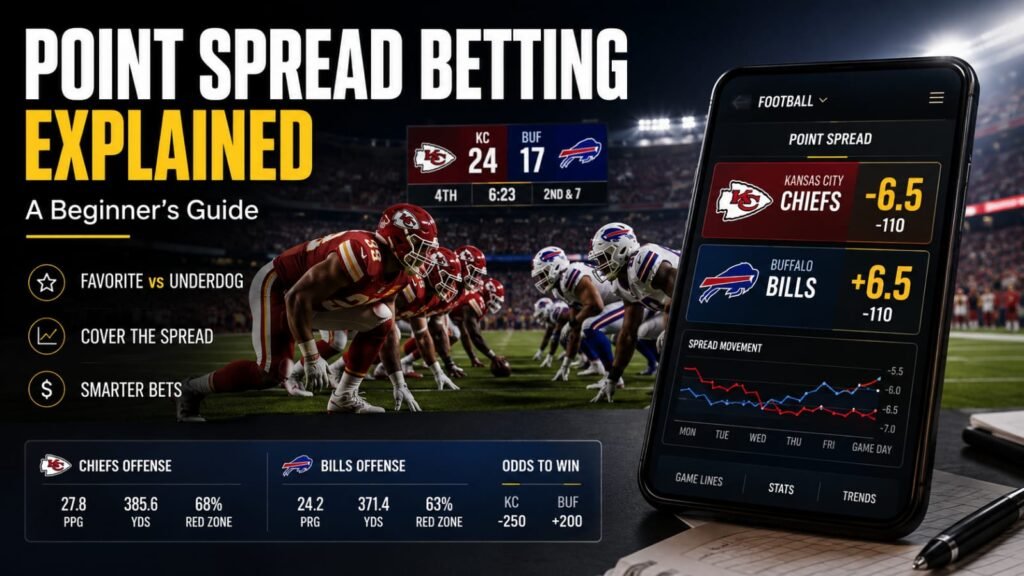
Kansas City Chiefs -6.5 Buffalo Bills +6.5
Chiefs favored by six and a half. Bet them, they need seven or more. Bet the Bills, they can lose by six or less, or just win, and either way you cash.Why the half point? Without it, a final score landing exactly on the number, say a 6-point spread and a 24-18 final, means nobody wins the bet. That’s a push. Your money comes back, no win, no loss. Books hate that outcome as much as bettors do, so most spreads carry a half point specifically to make it impossible.
Covering the Spread
“Covered the spread” gets thrown around a lot and it just means a team beat the number, win or lose.
Bills at +6.5, they lose by three. Didn’t win the game. Covered the spread anyway, since three is less than 6.5. Anyone who bet Buffalo at that number wins the bet regardless of what the final score says on paper.
That’s the whole appeal, honestly. A blowout stays interesting because a late touchdown from a team that’s already lost can still flip somebody’s bet slip.
Where You’ll See Point Spreads
Basically every sportsbook, sitting right next to the moneyline and the total. Football uses them the most, but basketball leans on spreads just as hard. And now esports does too. CS2 spreads run on rounds. League of Legends spreads often run on kills instead of points, since “final score” doesn’t quite mean the same thing in a video game.
Check our guide to reading esports betting lines if that side of things interests you more than football does.
Getting Better at Spread Betting
A few things separate people who actually win over time from people who just guess and hope.
Shop the number. Seriously. A half point difference between two sportsbooks sounds tiny, but string that across a full season and it adds up to real money left on the table.
Watch it move. If a line goes from -3 to -5 in the day before kickoff, that’s not random. Heavy money is landing somewhere, and it tells you where the public’s leaning even if you end up disagreeing with them.Injuries change everything, fast. A starting quarterback ruled out an hour before kickoff can swing a spread two or three points in minutes. Bet too early and you might be locked into a number that doesn’t reflect reality anymore.
And don’t chase. Losing one bet and immediately doubling the next one is how a rough Sunday turns into a genuinely bad month. The National Council on Problem Gambling suggests setting a budget before you start and actually sticking to it, which sounds obvious until you’re a few drinks in and down two bets already.
Mistakes People Keep Making
A handful of errors show up constantly with new bettors. Some think a push can happen on a half-point spread, it can’t, that’s the whole reason the half point exists. Others take the favorite just because they’re the better team, without checking whether the number’s actually worth the risk. And a lot of people never bother checking a second sportsbook, so they’re leaving free value sitting right there.
None of this takes real effort to fix. It just means pausing for a few seconds before you place the bet instead of after you’ve already lost it.
Getting Comfortable With the Spread
Once the number actually clicks, reading a spread stops feeling like homework. You start spotting value that people scrolling past on their phones never notice.
Start small. Track a handful of games without money on them first. Watch how the numbers shift over a week or two. Do that for a month and you’ll read a betting line faster than plenty of people who’ve been doing this for years.
FAQ
What does a point spread mean in betting?
The point spread is a figure set by sportsbooks to make a game between two teams fair where one is better than the other. The favored team will have to win the game by a greater margin than the figure provided for it to cover the bet, while the other can lose the game by a smaller margin than the figure or win the game and still cover the bet.
What occurs in case the game falls on the point spread?
This scenario is referred to as a push and it will only happen if the point spread is a whole figure, say 6 or 7.
Is point spread betting better than moneyline betting?
Neither is better across the board. Moneyline betting is simpler since you’re only picking the winner, while point spread betting can offer better value on favorites since the payout is closer to even money.
What Makes Point Spreads Fluctuate Prior to a Game?
Spreads shift based on where the betting money is going and any late news, like injuries. A big shift usually means heavy betting on one side or a change in a key player’s status.